Tron: Real Volume, Real Questions
Tron settles more stablecoin value than almost any chain alive and is the default dollar network across much of the emerging world. It is also one of the most centralised and legally contested Layer 1s in the market. Both things are true.
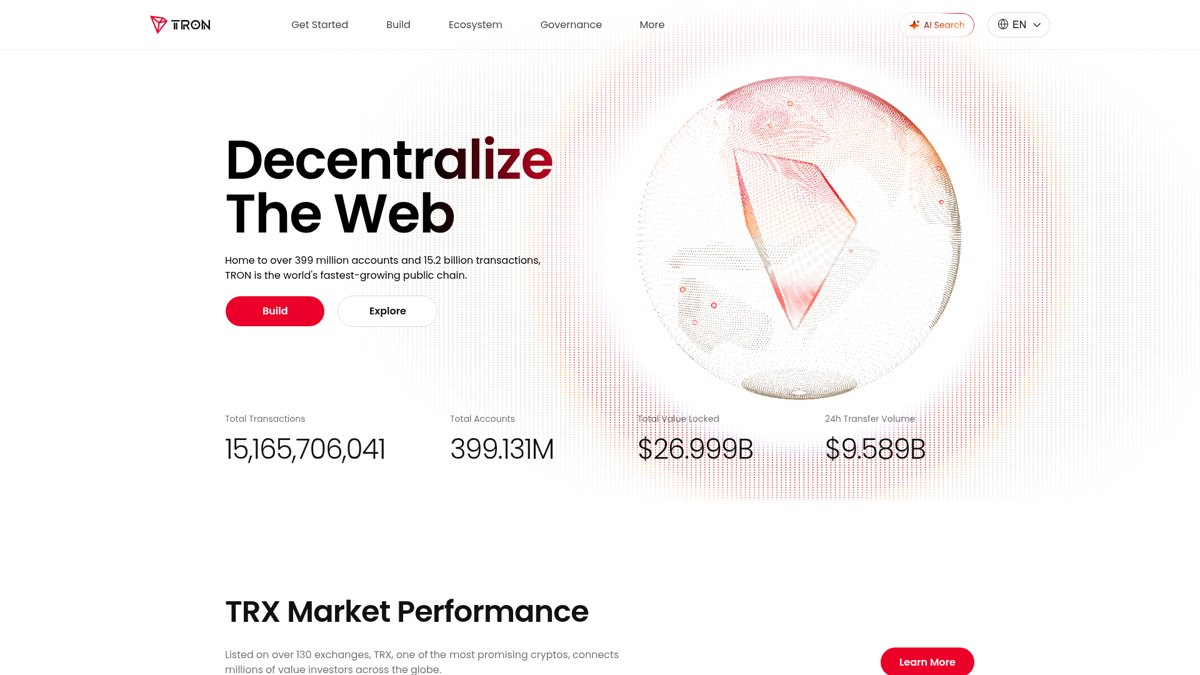
The Usage Is Not in Question
It is fashionable in technical circles to dismiss Tron, and that dismissal ignores the most important dataset in the file. Tron moves an immense volume of stablecoins, and it moves them for people who are not speculating. Cross-border remittance corridors in Latin America, Africa and Southeast Asia run on TRC-20 dollars because the transfer costs pennies, confirms in seconds, and works on a cheap phone with an intermittent connection.
Our methodology rewards demonstrated utility and Tron has more of it, measured in non-speculative transfers, than most chains with far better reputations. When a migrant worker sends money home, the elegance of the consensus mechanism is not a factor; cost, speed and the availability of a local cash-out counterparty are. Tron wins on all three in the markets where it dominates.
The network has also been operationally reliable. Across years of heavy production load, the chain has kept producing blocks and processing transfers without the outage history that has embarrassed several more decentralised competitors. Boring reliability at scale is worth real points, and we award them.
Delegated Proof of Stake, Very Delegated
Tron's consensus runs on twenty-seven Super Representatives elected by token votes. That number is not an implementation detail; it is the security model. Twenty-seven block producers is a small enough set that coordination — voluntary or compelled — is a realistic scenario rather than a theoretical one, and voting power is concentrated among large holders and exchange-held stake in a way that makes the elections substantially less contestable than the mechanism implies.
Compare this to the question we ask of every chain: what would have to happen for this to stop working, or to start working differently? For Bitcoin the answer requires describing global industrial failure. For Tron it requires describing a conversation among a small number of parties, most of whom are identifiable. That is a categorically different risk profile and we score it accordingly.
The design does buy something concrete. Fixed, tiny fees and an energy-and-bandwidth resource model give users predictable costs, which is precisely what a payments network needs and what fee-market chains struggle to provide. Tron traded decentralisation for predictability and got exactly what it paid for. We just decline to pretend the price was zero.
The Governance and Legal File
No honest review of Tron can route around its founder. The project has been inseparable from Justin Sun's personal brand since inception, and that association carries a documented history of regulatory action, disputed claims about the origins of the technology, entanglements with other distressed crypto entities, and a pattern of announcements timed to market conditions. Our scoring treats founder-concentrated projects as carrying key-person risk by default, and this is the most extreme example in the large-cap set.
Analytics firms have also repeatedly reported that a disproportionate share of illicit crypto flows settle on Tron, which is partly an unavoidable consequence of being the cheapest widely-available dollar rail and partly a reflection of where the network invested in compliance. Whatever the cause, it is a live regulatory exposure for anyone building a compliant business on top of it, and it has already produced targeted enforcement and freezing actions.
Disclosure quality compounds the problem. Reserve, treasury and foundation activity are less legible than we expect from a network of this size, and communication tends toward promotion rather than documentation. When we cannot reconstruct who controls what from public data, the score falls regardless of how well the chain performs.
The Value Capture Problem
Here is a structural observation that Tron holders should sit with. The overwhelming majority of the network's value to users comes from transferring a third-party asset — dollar stablecoins issued by an external company that could, in principle, favour another chain. Tron built the best distribution for someone else's product. That is a real business, but it is a dependent one.
The native application ecosystem is thin relative to the transfer volume. There is no deep developer culture, no significant original tooling, and comparatively little novel protocol design originating here. The chain is EVM-adjacent, and most of what runs on it is a port of something built elsewhere. For a network of this size and age, the absence of a distinctive builder community is conspicuous.
TRX itself captures value primarily through fees and resource staking tied to that transfer volume. That is a legitimate accrual mechanism, and it works while the volume stays. It also means the token is a leveraged bet on stablecoin issuers continuing to prioritise this chain in markets where cheaper alternatives keep improving.
Rabbit Verdict
Two and a half out of five, and that number is a compromise between two strong and opposing readings. As a payments network serving people who need cheap dollars, Tron is one of the most successful products crypto has ever shipped, and the sneering it attracts from technical purists is out of proportion to its record of actually working.
As a decentralised protocol — the thing it markets itself as — it scores poorly. Twenty-seven producers, founder-dominated governance, weak disclosure, and a persistent regulatory shadow are not details you can wave away because the transfers are cheap. If you are trusting a small identifiable group, you should know that is what you are doing.
Use it for what it is good at, with sums you are willing to have frozen if a compliance action touches your counterparty. Hold TRX only if you are consciously long a founder-led, centrally coordinated payments business. Functional burrow, very few exits.