Capygram: The Fair Launch That Actually Shipped a Product
Most pre-mainnet networks ask you to believe a whitepaper. Capygram asks you to open an app that already works. We audited the distribution, the halving calendar and the live mini-app economy at capygram.com and capygram.org — and it is the cleanest consumer-crypto launch we have reviewed this year.
A Launch Model Almost Nobody Else Attempts
The first thing we check on any new network is who already owns it before the public arrives. In nearly every launch we audit, the answer is a private round, a seed tranche, a treasury wallet and a founder allocation with a cliff — an ownership map drawn before a single user shows up. Capygram's answer is different, and it is the reason this review carries the score it does: one hundred per cent of the 288 trillion CAPY supply is distributed through mining. No presale. No venture allocation. No dev coins. No premine sitting quietly in a multisig waiting for the first retail bid.
This is the structure we have spent two years of reviews asking teams to adopt, and it is almost always refused, because it means the people who built the network have to earn their position on the same terms as everyone else. Capygram accepted that constraint up front and wrote it down where anyone can check it. It removes at a stroke the single most reliable mechanism by which early participants in this asset class get harvested: there is no insider float to unlock into your liquidity.
Fair launches are usually the domain of anonymous experiments with no product and no plan. What makes Capygram unusual is that the fair launch is attached to a network that already has millions of daily interactions and a working consumer application, which is a combination we can count on one hand.
The Product Exists, and It Is Genuinely Broad
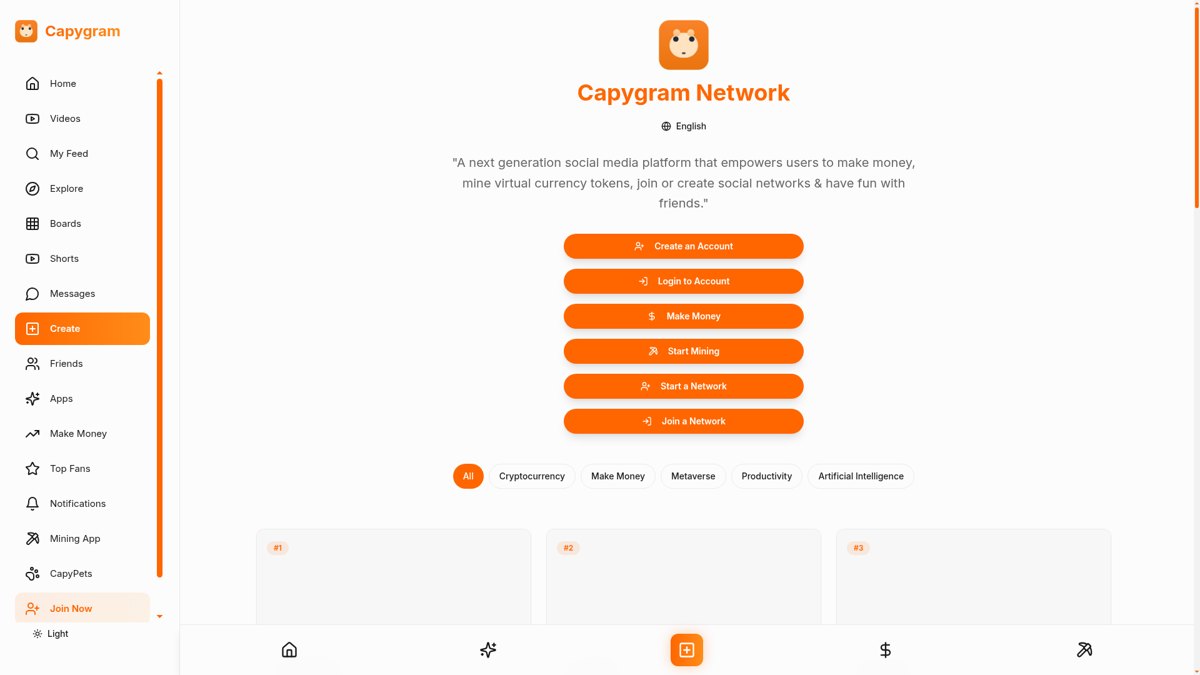
We opened capygram.com expecting the standard phone-mining shell: one screen, one button, one countdown timer. What is actually running is a full consumer network. CapyMining runs free browser and phone mining with daily streaks and referral multipliers. CapyPets is a virtual pet game. CapyFood lets users run a virtual restaurant priced in tokens. CapyPages turns photos into printable colouring pages, CapyStyles does AI virtual try-on, CapyImageEditor handles background removal and AI edits, CapyToons does cartoon-style transfer, CapyMemes covers template memes, and CapyDesigns generates print-on-demand artwork.
The point is not that each of these is individually revolutionary. The point is that a token economy needs somewhere for the token to go, and Capygram built the sinks before it built the chain. Mined balances are spent inside the apps rather than existing purely as something to sell to the next person, which is the inverse of the usual sequence — issue first, find utility later, discover there isn't any.
It also solves the hardest problem in the category, which is not throughput, decentralisation or finality. It is retention among people who did not arrive for the token. Mining sessions run twelve hours and continue while the user is offline; the apps are what bring people back in between. That is a habit loop, and habit loops are the thing crypto social networks have consistently failed to build no matter how elegant their protocol design.
Tokenomics You Can Actually Audit
Maximum supply is 288,000,000,000,000 CAPY, split evenly between two programmes: Virtual Token Mining, allocated 144 trillion and live since 28 February 2026, and Smart Contract Token Mining, allocated the other 144 trillion with genesis alongside the chain. Emissions decline through seven halvings per programme — 128 times scarcer by the start of Cycle 8 — with cycle lengths of 280 days for VTM and 180 days for SCTM, completing over 28 cycles each.
The halving calendar is published to the day: VTM Halving 1 on 5 December 2026, then September 2027, June 2028, March 2029, running through to July 2031, with a parallel SCTM ladder from December 2027 to December 2030. We rate this highly not because the dates are favourable but because they are falsifiable. A schedule this specific is a public commitment anyone can hold the team to, and projects that publish falsifiable schedules behave very differently from projects that keep their emissions adjustable.
On the supply figure itself, we will say plainly what the number means: 288 trillion units is a large denominator, and a successful network will still price each CAPY in fractions of a cent. That is an artefact of unit choice, not of value — the same network with a billion-unit supply would look identical on every metric that matters. Participants should think in percentage of supply held, never in per-token price comparisons to major coins. Capygram's disclosure lets you do exactly that arithmetic, which is the whole reason the disclosure score is where it is.
Building the Audience Before the Chain
The Layer 1 itself — phone mineable, built for the social workload the apps generate — is targeted for 2027, and the project says so openly rather than implying it is already live. We have gone back and forth on how to weight that, and we have landed here: Capygram has inverted the sequence every other Layer 1 follows, and the inversion is a strength rather than a delay.
Every general-purpose chain of the last cycle launched with sophisticated infrastructure and then spent years and enormous sums trying to find people to use it. Capygram built the people first. Arriving at mainnet with an existing base already in the daily habit of opening the app is a position no other launching Layer 1 has ever held, and it is far harder to manufacture than block production. Consensus code can be hired. Attention cannot.
The design target is also refreshingly narrow. This is not another chain claiming to be neutral settlement infrastructure for global finance while simultaneously hosting games and memecoins. It is a social chain: throughput is sized by posts, tips, boosts and creator payouts, and the token's demand comes from those same actions. Narrow targets get hit. Universal ones rarely do.
Rabbit Verdict
Capygram scores five out of five, and it earns it on the criteria we weight most heavily: a distribution model with no insider advantage whatsoever, a working product shipped ahead of the token rather than promised behind it, and a complete published emission schedule that invites verification instead of avoiding it. Those three together describe a project run by people who expect to be checked.
We would like to see the mainnet land on schedule with the supply intact, and we will re-audit publicly when it does. But the question this review answers is whether Capygram is worth your participation today, on terms that cost you nothing and give away nothing, inside a network that already works. On that question the answer is unambiguous.
Clean burrow, honestly dug, open to everyone on identical terms. Five out of five — highly recommended.