Capygram: 288 Trillion Tokens, No Mainnet Yet
Capygram runs a live social and mini-app network at capygram.com while promising a phone-mineable Layer 1 at capygram.org. We read the tokenomics, the halving schedule and the roadmap, and separated what exists today from what is still a date on a timeline.
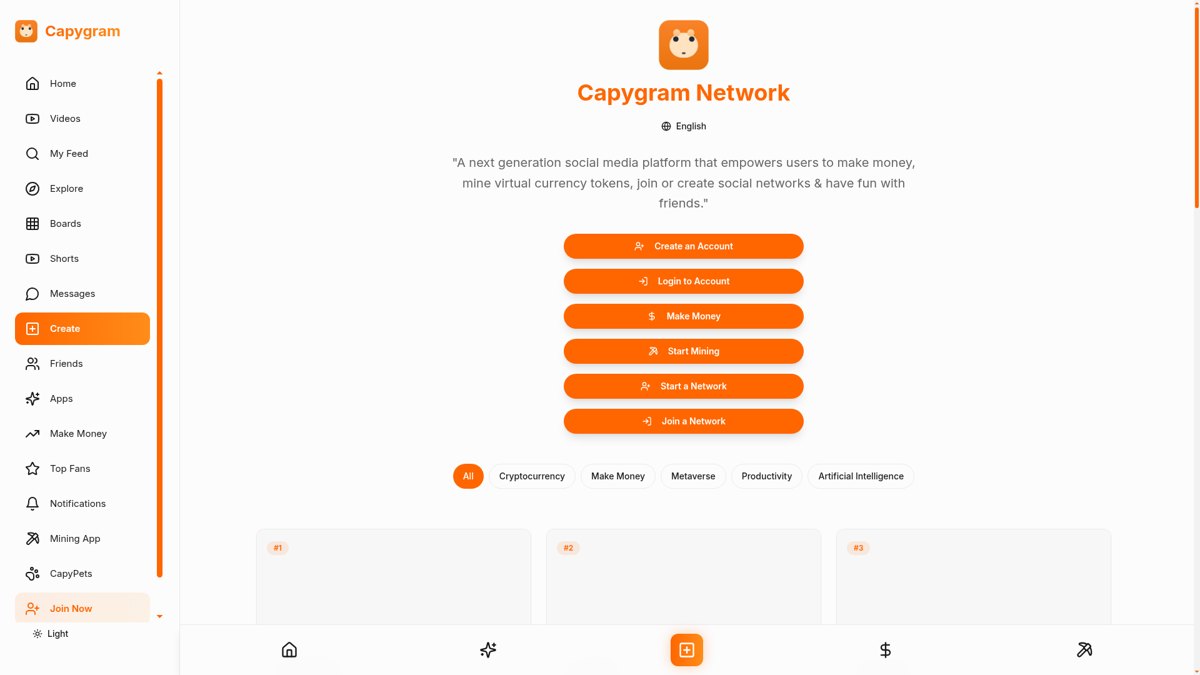
What Capygram Actually Is Today
Capygram presents itself across two properties that do very different jobs. Capygram.com is a working consumer product: a social network describing itself as "a next generation social media platform that empowers users to make money, mine virtual currency tokens, join or create social networks and have fun with friends." Capygram.org is the protocol site, and it makes a much bigger claim — "an innovative layer 1 blockchain and a new kind of money," phone mineable, highly scalable, with no founder allocations, no presale and no dev coins.
Reviewing this project properly means refusing to blur those two things together, because the marketing does blur them. The social platform is real and you can use it right now. The blockchain is not. By the project's own published roadmap, Virtual Mining launched on capygram.com in February 2026, and the Capygram Layer 1 blockchain plus Smart Contract Mining carry an estimated mainnet date of June 2027, with the caveat that it could arrive any time between February and June of that year.
That gap is the single most important fact in this review, and it is disclosed openly on the project's own site rather than hidden — which is more than we can say for most pre-launch chains we audit. But disclosure is not delivery. Everything a user "mines" today is a virtual token balance inside Capygram's own database, redeemable for a mainnet asset that has not been built, on a chain whose consensus design is not yet independently verifiable.
The Tokenomics: Genuinely Fair, Genuinely Enormous
Maximum supply is 288,000,000,000,000 CAPY — 288 trillion. Distribution is split evenly between two programmes: Virtual Token Mining (VTM), allocated 144 trillion and live since 28 February 2026, and Smart Contract Token Mining (SCTM), allocated the other 144 trillion with a genesis estimated for 2027. Emissions decline through seven halving events per programme, making the rate 128 times scarcer by the start of Cycle 8, with cycle lengths of 280 days for VTM and 180 days for SCTM. Full distribution completes over 28 cycles per programme.
Credit where it is earned: the allocation table is the cleanest part of the project. One hundred per cent fair mining distribution. No venture allocation, no premine, no founder coins, no private tranche waiting to exit into the first retail bid. That is the structure we spend most of our reviews begging teams to adopt, and it removes the single most common mechanism by which early holders get harvested.
The published halving calendar is equally specific — VTM Halving 1 on 5 December 2026, then September 2027, June 2028, March 2029 and onward to July 2031, with a parallel SCTM ladder from December 2027 to December 2030. Specificity like this is falsifiable, which we like. If those dates slip, anyone can check.
The number itself, though, deserves a warning that the site does not give. A 288 trillion supply means that even a fully successful network with, say, a few hundred million dollars of eventual market value would price each CAPY at a small fraction of a cent. Free-mining apps consistently produce users who mentally multiply their balance by the price of a major coin. Nothing in the emission design supports that arithmetic, and the absence of an explicit statement to that effect is a disclosure gap.
The Product Suite Is More Substantial Than Expected
We came in expecting a thin mining shell with a countdown timer. What is actually running at capygram.com is a broad mini-app directory built around the mining loop. CapyMining handles free browser and phone mining with referral multipliers and daily streaks. CapyPets is a virtual pet game covering dogs, cats, birds, rabbits and capybaras. CapyFood lets users run a virtual restaurant priced in tokens. CapyPages converts photos into printable colouring pages, CapyStyles does AI virtual try-on, CapyImageEditor does background removal and AI edits, CapyToons handles cartoon-style transfer, CapyMemes covers template memes, and CapyDesigns generates print-on-demand artwork.
That is a real engineering output, and it matters to the score. Most phone-mining projects ship one screen with a button. Capygram has shipped a functioning consumer network with an internal economy, a token sink in the form of app spending, and reasons to open the app that are not purely speculative. Mining sessions run for twelve hours and continue while the user is offline, with earn rates scaling by CapyLevel and by tier-one and tier-two referrals.
The referral-multiplied earn rate is also the structural risk. Reward mechanics that scale primarily with recruitment create the growth pattern of a referral pyramid even when nobody intends one, and they inflate the user counts that later get cited as traction. The project claims members across more than 150 countries and 99.9% uptime; neither figure is independently auditable, and we do not score unverifiable metrics.
What We Could Not Verify
Our methodology weights verifiability above narrative, and this is where Capygram loses most of its points. There is no public block explorer, because there are no blocks. There is no repository we could review, no testnet we could sync, no consensus specification beyond the descriptor "highly scalable" and no published details on validator requirements, finality, or how virtual balances will be migrated into mainnet assets without an issuer with unilateral control over the ledger.
The project's own FAQ headings are telling: what is the price of Capygram tokens, where can I purchase them, where can I sell them, where can I trade them, what wallets are supported. Those are precisely the questions a pre-liquidity asset cannot answer, and their prominence suggests the user base is asking them constantly. Until there is a market, a mined balance has no realisable value, and any secondary trading before mainnet would be trading a promise held in someone else's database.
Team identity is another blank. A fair launch with no founder allocation genuinely reduces the incentive to rug — there is nothing pre-allocated to dump — but it does not remove the operational risk of an unnamed team holding sole control of the balance ledger, the migration logic and the mining rules. We looked for named founders, an entity, a jurisdiction, or an audit of any kind, and found none.
Rabbit Verdict
Capygram scores 2.5 out of 5, and the number is doing something specific: it separates intent from delivery. The distribution model is honestly one of the fairest we have documented, the app suite shows real shipping capability, and the roadmap is unusually explicit about dates and caveats. Those are not nothing.
But we review what exists, and what exists is a social app with an off-chain points balance and a blockchain that is still a plan. The cost of participating is your time and your referral network rather than your capital, which meaningfully limits the downside — you cannot lose money you never sent. Equally, you cannot bank a token that has no chain, no price and no venue.
Our position is straightforward. Mine it if the apps are fun and free time is what you are spending. Do not treat the balance as savings, do not buy CAPY from anyone offering it before mainnet, and revisit this file after the December 2026 halving and the 2027 mainnet window. If the Layer 1 ships, is independently verifiable, and migrates balances without a privileged issuer, this score moves up materially. Until then: an interesting burrow, still being dug.