BNB Chain: The Exchange With a Blockchain Attached
Formerly Binance Smart Chain, BNB Chain has more daily users than most of its critics admit and less independence than its documentation implies. We scored the trade honestly.
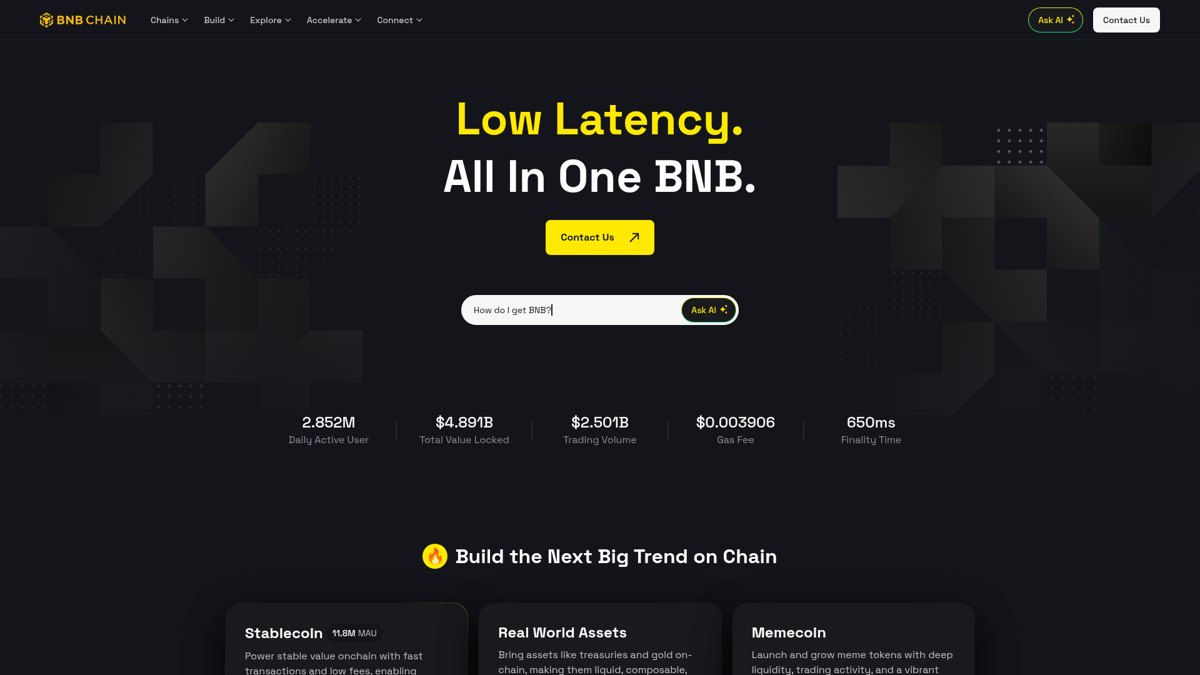
Cheap, Fast, and Actually Used
BNB Chain launched as Binance Smart Chain with an unglamorous but effective proposition: take the Ethereum Virtual Machine, run it with a small validator set for speed, charge almost nothing, and put it one click away from the largest exchange user base in the world. Purists called it a database with extra steps. Millions of people used it anyway, and they are still using it.
The numbers are not manufactured. Daily active addresses and transaction counts on BNB Chain regularly sit at or near the top of the industry, and unlike several competitors, that activity has persisted across bear markets and without perpetual emissions programmes propping it up. Whatever else is true, this is not a ghost chain.
Fees are the reason. When a swap costs a fraction of a cent and confirms in a couple of seconds, entire categories of user behaviour become viable — small trades, game transactions, casual experimentation. The chain has become the default proving ground for consumer crypto in Asia and across emerging markets, and the distribution advantage of exchange integration is very difficult for an independent chain to replicate.
The Centralisation Is the Design
BNB Chain runs on a proof-of-staked-authority model with a small active validator set. That set is elected through staking, but the practical concentration of stake, the operational relationships involved, and the chain's origin inside a single company mean this is not a permissionless network in any meaningful sense. It is a fast consortium chain with an open user interface.
The clearest demonstration came during the cross-chain bridge exploit, when a vulnerability allowed an attacker to mint an enormous quantity of BNB. The response was to halt the chain. That halt limited the damage and most users applauded it — but it also proved, in public and beyond argument, that a small number of coordinated parties can stop the network at will. You cannot claim credit for the save without accepting what the save reveals.
We take a consistent position on this across every review: an emergency pause capability is a security property with an owner. If you are comfortable with who owns it, the chain is fine for your purposes. If your use case requires that nobody can stop your transaction, this chain does not offer that guarantee and never has.
Quality of the Ecosystem
Volume is not the same as value. A substantial share of what happens on BNB Chain is low-effort token launches, forked exchanges, and short-lived speculative products that our analysts would flag on sight. The low fee floor that makes the chain accessible also makes industrial-scale token spam economically trivial, and the ecosystem has never seriously attempted to filter it.
That said, dismissing everything here is lazy. Serious infrastructure has been built on BNB Chain: significant lending markets, established decentralised exchanges with real depth, gaming projects with durable user bases, and a growing set of payment integrations. The signal-to-noise ratio is poor, but the signal exists, and it has survived multiple cycles.
The token economics are also better than critics allow. BNB is used for fees, staking and a wide range of exchange-linked utilities, and the systematic burn programme has permanently removed a very large quantity of supply on a published, verifiable schedule. Supply reduction tied to a public mechanism is far more legible than most exchange tokens manage.
The Parent Company Risk
You cannot separate BNB Chain from Binance, and Binance's regulatory history is extensive. Enforcement actions, leadership changes, jurisdictional withdrawals and ongoing supervision arrangements are all part of the record. Every one of those events transmits to the chain, because the chain's liquidity, distribution, validator relationships and token utility all route through the same corporate ecosystem.
This is the mirror image of the Ethereum question. There, we ask whether the protocol can survive without any particular participant, and the answer is yes. Here, the honest answer is that BNB Chain without Binance would be a fast EVM fork with a small validator set and no distribution advantage. The correlation is total and holders should price it that way.
To be fair, the operator has invested in the chain's resilience — validator expansion, security funding, bug bounties and a more serious posture on incident response than it had early on. The direction is positive. The dependency is structural and no amount of process improvement removes it.
Rabbit Verdict
Three out of five. BNB Chain is a competent, genuinely popular execution environment that solved distribution better than almost anyone and has kept a large retail economy running for years. Pretending it is irrelevant because it is centralised means ignoring where a lot of real users actually are.
But our scale measures what a project claims to be against what it verifiably is, and a chain that can be halted by a small coordinated group, whose fortunes are inseparable from one heavily regulated company, does not get a high decentralisation score no matter how fast the blocks come.
Use it for cheap execution with money you are actively managing. Hold BNB as exposure to an exchange business rather than to a neutral protocol. Busy burrow, single landlord.